Heavy legs and swollen ankles in the evening: why it happens (even if you haven't been walking)
Have you ever reached the end of the day, taken off your shoes, and felt a sense of relief mixed with pain?
Maybe you look at your ankles and see the clear imprint of your sock elastic. Your legs feel heavy, like lead, and there's a slight tingling sensation that won't give you any peace, even when you lie down on the sofa.
The strange thing is that this sensation often doesn't come after a 20 km mountain hike. It comes after a day spent at a desk, standing behind a counter, or perhaps after hours of doing housework.
Let’s be clear: it’s not just "old age" or general fatigue. It’s a matter of hydraulics.
Gravity is unforgiving
Our body is a marvelous machine, but it has a constant enemy: the force of gravity. The heart pumps arterial blood to the feet with ease (because it's going downhill), but venous return—the blood that has to travel back up from the feet to the heart—is a challenge.
When we walk, the calf muscle pump and the rolling motion of the foot help push the blood upward.
But when we are still? Or when we are sitting for hours?
That’s when the system breaks down. Fluids stagnate at the bottom, ankles swell, and toxins remain in the muscles instead of being flushed out. That is why your legs feel "full" and tired at night.

They aren't just for the mountains
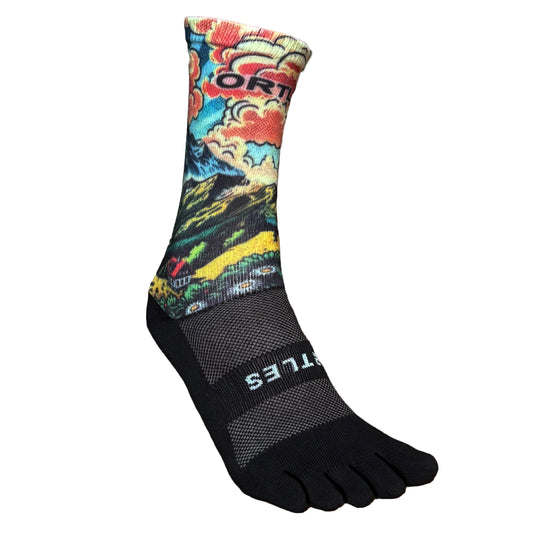
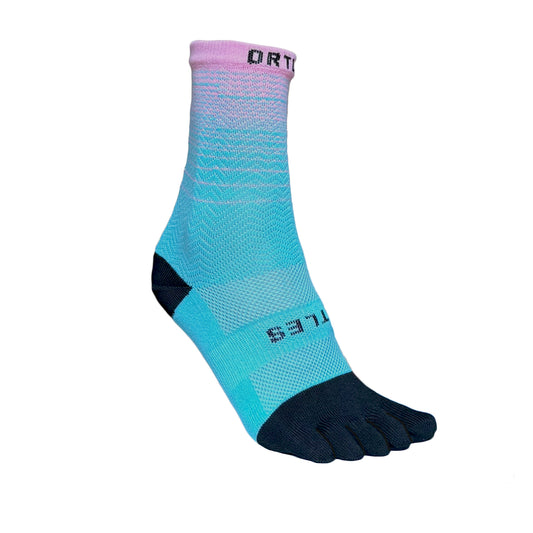
Many people only think of our Flow socks (the knee-high ones) for long treks or post-race recovery. Sure, they were designed for that. But the truth is that I personally use them very often in everyday life.
When we spend hours in the warehouse preparing your orders, or when I'm at a trade show talking to you all day while standing, compression socks are my lifesaver.
They aren't a "cast." A good graduated compression sock shouldn't just squeeze at random. It must exert firm pressure at the ankle that decreases as it moves up toward the calf.
It’s like having a constant, imperceptible massage that helps your body do what it can't quite manage on its own at that moment: push fluids upward.
Why do free toes make a difference here too?
You might ask: "Okay, I understand the compression on the calf, but what do five toes have to do with it if I'm sitting in the office?"
They have everything to do with it.
Traditional compression socks often compress everything, squeezing your toes in a vice. This is counterproductive.
Our Flow socks combine two actions:
- On the leg: they aid venous return and reduce swelling.
- On the toes: they allow total freedom.
Having separate toes allows you to move them freely even inside your shoes (or slippers at home). Moving your toes, even while seated, is a small engine that activates foot circulation.
If you lock your toes in a tight bag, you block everything. If you leave them free and assist the calf with compression, you create the perfect environment for foot wellness.

The result at the end of the day
You feel the difference when you take them off. Instead of having swollen ankles and that feeling of heaviness, your legs are lighter, less puffy, and rested.
It’s a little trick that athletes use, but in reality, it’s even more useful for those who live a normal life, work, stand for long periods, or simply want to take care of their legs without waiting until they are in pain.
If you suffer from these discomforts at the end of the day, try wearing them on a morning when you know you'll be standing or sitting still for a long time. Let me know what you think in the evening.