The secret to restarting pain-free on multi-day hikes
Anyone who has taken on the Via Francigena, the Camino de Santiago, or a multi-day trek knows this very well. The real problem is almost never the first day.
On the first day, you run on adrenaline, enthusiasm, and new scenery. The real hurdle arrives on the morning of the second or third day. When the alarm clock goes off in the hostel or tent, you put your feet on the floor and your calves feel like they're made of wood.
Every step toward the bathroom seems to weigh twice as much. And the thought of putting your backpack back on to walk another twenty kilometers makes you spontaneously ask: "Why on earth did I do this to myself?"
If you love long-distance walking and have moved past the exciting years of your youth, you know exactly what I'm talking about. We often resign ourselves, thinking that this muscle stiffness and these aches are inevitable, a sort of tax to pay for experiencing our adventure. But that's not exactly the case.
The secret is not to wait until the evening
The problem stems from how we manage fatigue kilometer after kilometer. By walking for hours, muscles undergo constant micro-trauma. Fluids and waste products from fatigue tend to stagnate downward, swelling the lower leg and inflaming the tissues.
If you wait until the evening to do some stretching, or hope for a cold shower to get back in shape, you are trying to curb the problem when the muscle damage has already been done. The key to avoiding the next day's pain is not to recover when you are stopped, but to recover while you walk. What is known in the industry as active recovery.

A continuous massage, step after step
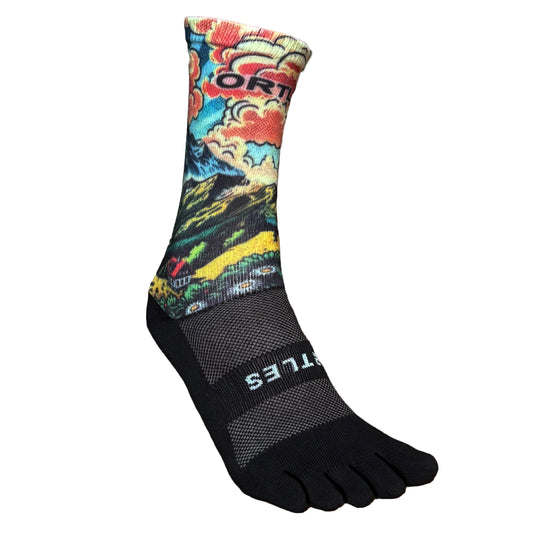
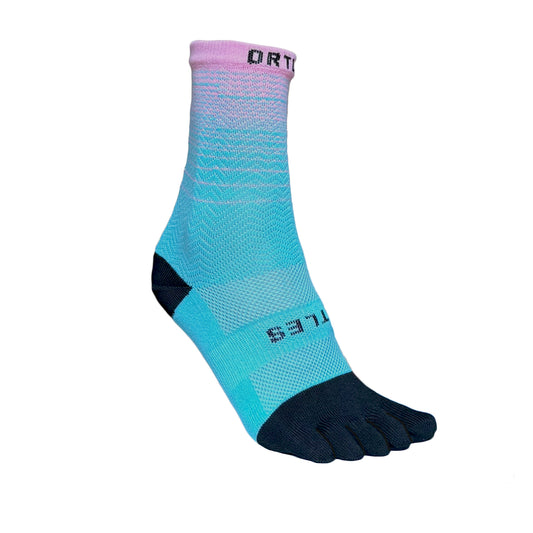
It is precisely in these situations that our Flow compression socks come into play. I designed and tested them specifically for those tackling long treks who need support that works quietly, hour after hour.
Graduated compression is not an aesthetic quirk or something for extreme athletes. It works exactly like a gentle, continuous massage: it exerts firm pressure at the ankle that gradually releases as it moves up toward the knee. This mechanism physically helps blood return upward while you are on the move, preventing your calves from swelling and accelerating the elimination of waste from the muscle.
In practice, you reach the end of the stage with legs that have already started to regenerate on their own.
Foot wellness starts with free toes
At this point, you might make a fair observation: why use five-toe socks for compression?
Because for us, pain reduction and general well-being always start with a natural approach. If you use a traditional compression sock, it will also squeeze your forefoot in a vice. But your toes, especially on a long trek, need space.
Even if you use regular trekking shoes rather than minimalist models, having separated toes allows the foot to move and splay naturally, following the principles of barefoot biomechanics. Free toes absorb the impact with the ground and activate the plantar "pump," which is essential for pushing blood upward and making you tire less.

Ready for day two
Let’s be clear: using the right socks won't make fatigue magically disappear. Kilometers remain kilometers, and you will certainly be tired in the evening.
But the next morning, when you put your feet on the floor again, you will feel the difference. Your calves won't be like marble. You will feel legs that have shed much of the load and are supple, unswollen, and ready to set off again without having to grit your teeth for the first few kilometers.
If you have a long trek planned, try facing the day with this support. Feeling your legs working with you, instead of protesting, completely changes the flavor of the entire trip.