Inside the Ortles Haute Trail: how the 128km adventure went
128 kilometers, 8,000 meters of elevation gain, and a glacier over 3,000 meters above sea level. If these numbers sound impressive, I assure you that it is the battle with yourself that makes the Ortles Haute Trail a ruthless adventure.
This story actually begins long before September 11, 2026. It starts in February, when Marco De Gasperi officially announces a new race that will circle the Ortles massif. The name? Ortles Haute Trail. I immediately take a look: the route follows the Ortles High Trail (Alta Via dell'Ortles), a tour I had always wanted to do but had always postponed for logistical reasons.
Furthermore, having given the name to our brand, ORTLES RUN, how could I ignore it? On February 23, my birthday and a couple of days after registration opened, I decided that this would be my long race of 2026.
The Numbers and the Anticipation
The months pass quickly. Three weeks before the event, I decide to test a section of the course, from Bormio to the Quinto Alpini mountain hut, and I immediately understand what this race is made of. Let's start with some data to frame the challenge:
- Distance: 128 km.
- Elevation gain: 8,000 meters positive.
- Altitude: The majority of the route is between 2,500 and 3,100 meters.
- Extra difficulty: Glacier crossing with micro-crampons.
Weather reports in the days leading up to the race caused some concern: the weather had been bad, it had rained, and there was snow above 2,600 meters. However, the organization worked perfectly and was super updated. The "cold kit" was activated, making it mandatory to carry extra thermal layers.
The Start: From Meadows to the Glacier
Friday morning, 9:30 AM: we set off from Bormio. First, though, the usual equipment check and collection of the GPS tracker to ensure we can always be located.
A fast start in the town, then we switch to a woodland section on a runnable trail. Knowing this part of the route, I know you need to go slowly to save your legs, even if the adrenaline pushes you to do the opposite. We climb up a beautiful single track with a view over the entire Val Zebrù, pass the Costantini bivouac (2,327m), and descend into the valley to tackle the first real climb toward the Rifugio Quinto Alpini (2,877m). Here the landscape changes: from green meadows to high mountain rocks, with the gradients increasing sharply.
After 3 hours, I decide to relax my pace. The race is long and we are only at the 25th km. Once I reach the aid station, I fill my flasks and eat a jam sandwich (it will be the snack that accompanies me to every aid station until... no spoilers!).

We descend toward Passo Zebrù (3,000m), where we find the first remnants of the snow that fell in the previous days. The view up there is magnificent, almost a 360-degree panorama. But there isn't much time to think: we need to reach the Pizzini and Casati mountain huts as soon as possible due to the strict cut-off times before the glacier. I admit that my thoughts are all there: I've never been on a real glacier and I can't wait.
My pace remains steady, I keep an eye on my heart rate and, thanks to the aid stations, I even eat more than expected. As we climb, it gets cooler and it's time to layer up: arm warmers, gloves, a vest, and a neck gaiter to protect myself from the wind. Luckily, the sun will shine for both days of the race.
I arrive at the Rifugio Casati and am met by the expanse of the glacier which, with the fresh snow, looks like a soft, white duvet. The mountain guides tell us to put on our micro-crampons, and off we go! The track is well-marked and slightly downhill. Obviously, there is some slipping due to the snow churned up by the participants before us. It seems like only a minute has passed when another guide tells me I can take off my micro-crampons. I turn around and think, "Already?". I was having too much fun.
A long descent follows into Val Martello down to the Rifugio Nino Corsi, losing about 1,000 meters in altitude, before tackling another critical point: the Passo del Madriccio (3,123m). The climb is murderous, long, and with the last part definitely steep. I've known for a long time that I struggle at these altitudes, and, as expected, I get breathless. When I reach the top, however, I get a magnificent close-up of the Ortles just at sunset.
The Night, Nausea, and the (Almost) DNF
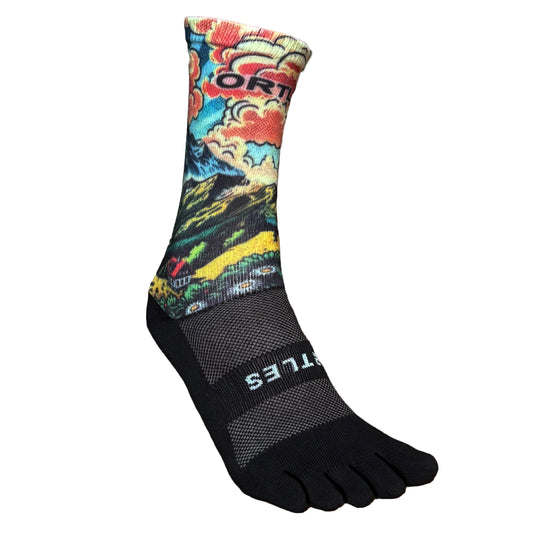
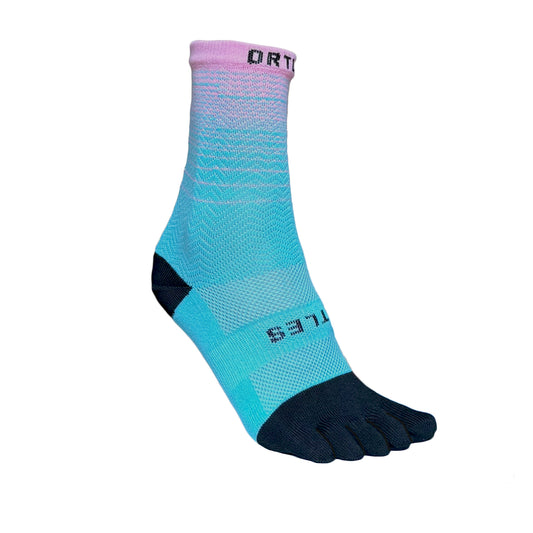
Another long descent towards Solda, where the base camp with my drop bag is located. I arrive at 8:00 PM on the dot, half an hour ahead of schedule. I prepare for the night: I change my socks to the Air Flow ones to take advantage of the compression, put on a long-sleeved shirt, gloves, a double headband (neck and head), a thermal tank top, and a jacket.
After 20 minutes in the base camp, I turn on my headlamp and head up a ski slope. After just half an hour, I feel like something is wrong. My stomach is acting up and nausea sets in. My backpack is full of gels, cookies, and bars, but the mere thought of them makes me want to vomit. With half the race still to go, this is not a good sign. Negative thoughts take over: I know full well that if you don't eat in a race like this, it's over.
I arrive at the Rifugio Serristori (2,721m) accompanied by my torment, I sit down, drink some Coca-Cola, and manage to get down only a piece of a cracker. My head hits a total low; I feel my energy fading. There are 14 km of nothing but downhill to the next aid station in the town of Stelvio. Descending is my strength, but I'm not running anymore. I sink into a mental abyss for two very long hours. I make my decision: I'm quitting.
At the aid station, my first words to the volunteers are: "I think I'm really going to quit." I turn off my Coros watch and upload the activity to Strava with yet another "DNF" title of the season. I have to wait a few hours to get back to town. I cover up, sit down, and start drinking hot tea. I drink at least half a liter. I chat with other runners and, after about twenty minutes, my mood and stomach improve. I try to eat some bread with jam and a few cookies. No discomfort. I do a final test with a gel: it goes down without any problems.
A plot twist: I hadn't officially announced my withdrawal yet! I get dressed and say: "If you see me back within 10 minutes, it means I've quit, otherwise I'm carrying on!". I walk a few meters and realize I feel great. I'm reborn.
The Endless Way to the Finish Line
I set off toward the Stelvio Pass: 15 km and 1,600 meters of positive elevation gain, without stopping. I keep a strong pace without effort, in the cold and wind, the climate I prefer. I begin to overtake those who had pulled ahead during my crisis, which gives me incredible confidence. I arrive at the Pass and even catch up to a guy I was with at the previous aid station, gaining 20 minutes.
I enter the heated mountain hut, eat rice and broth, and drink Coca-Cola. But as soon as I finish, another collapse: I become incredibly sleepy. I've never slept during a race and I don't want to start now. After 40 minutes I head out, but at 7 AM, with the sun rising and 24 hours of racing in my legs, the fatigue overwhelms me. I walk stumbling. Once I reach Bocchetta di Forcola (2,600m), I try a tactic I’ve never used before: I throw myself onto the ground among the rocks and sleep for 40 minutes. Upon waking, the sleepiness has passed, but my energy is at zero. 33 km to go, all downhill.

To make a long story short: from then on, I walked the whole way. My mind was fixed on quitting, but by now it was faster to just walk to the finish. I stopped eating, fading with every step. I dragged myself the last 10 km on the bike path at a pace of 13:50/km, with destroyed legs and aching feet. Knowing the route is a double-edged sword: if you're in pain, you know exactly how much of an ordeal awaits you.
When I saw the town, I admit, I started crying. I thought about how much I had suffered to get there and I broke down. Because at a certain point, it was all too much: too much pain, too tired, too many hours walking around.
I stepped to the side and pretended to do some stretching for a couple of minutes to move past that moment, to head toward the finish line. It wasn't my most beautiful finish, but certainly the one I wanted most.
I finished in 27 hours and 50 minutes (the prediction was 23-24 hours). The collapse is evident when looking at the splits:
First 56 km (4,500m D+): 10 hours and 30 minutes
Last 71 km (3,500m D+): 17 hours and 20 minutes

As I write this, it's Wednesday; four days have passed, which were necessary for the physical pain to subside and for me to regain my clarity.
If I think back to the race, I see myself on Friday feeling good, running well, and surrounded by magnificent landscapes. It was a shame that my race effectively ended in Solda, but as we know, the longer the race, the greater the chances that something will happen.
Ortles Haute Trail, you have everything it takes to become a great Italian long-distance classic. I will be rooting for you, and I will take with me the memory of myself at Passo del Madriccio watching the sun go down behind the Ortles.